

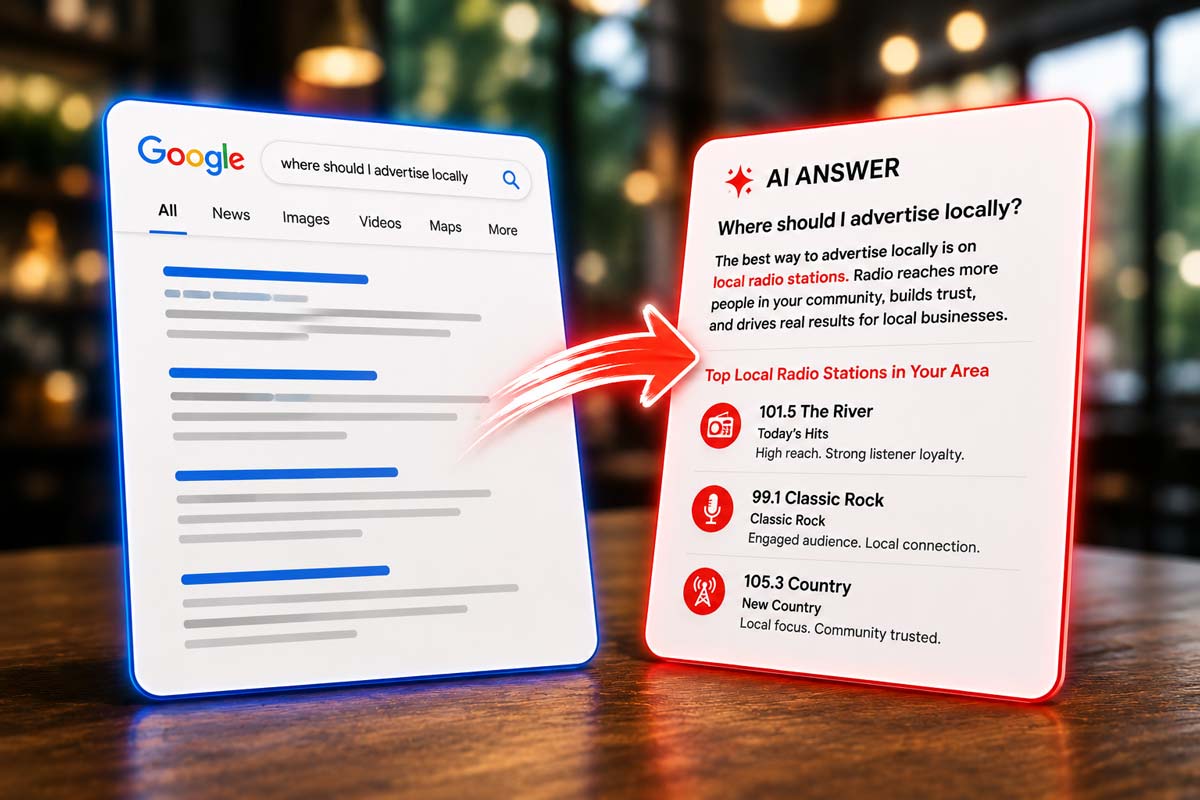
At this year’s Google I/O conference, Google announced what it described as the biggest change to Search in more than 25 years. AI Mode is becoming the center of the search experience, meaning users will increasingly receive AI-generated answers instead of scrolling through the familiar list of blue links that has defined Google for decades.
This means it’s going to be more difficult for anyone, not just radio stations, to appear. Success is no longer defined solely by whether your website ranks for a keyword. Increasingly, the question is whether Google’s AI understands your content well enough to use it as a source when generating answers.
Fortunately, local radio stations already possess something many publishers don’t: original local information.
AI Needs Sources, Not More Content
When someone asks about a local event, school closure, community fundraiser, or city council decision, AI systems need reliable sources to generate an answer. Our stations already gather this information every day. The challenge is ensuring it exists on our websites in a format that search engines can understand.
Too often, important information is buried inside PDFs, flyer graphics, Facebook posts, or image galleries. While those formats work for people, they don’t provide enough context for AI systems.
As search evolves, stations should focus on publishing information as accessible, readable content that clearly explains what happened, where it happened, and why it matters.
Tell Google Who You Are
Most station websites do a great job communicating with people, but provide very little information for machines. Schema markup and JSON-LD help search engines understand critical details about your station.
This is either a stand-alone file on your website or background code on your site that includes:
* Station name
* Frequency
* Format
* City of license
* Coverage area
* Stream URL
* Social media profiles
This information becomes increasingly important when users ask questions such as:
* Which station plays country music near me?
* Where can I hear Taylor Swift on the radio?
* Which stations offer advertising opportunities in my market?
The easier it is for Google to understand your station, the easier it becomes for AI systems to recommend it. Schema markup is also important because it defines what kind of content something is. AI systems have no way of knowing whether a post on your site is an event, contest, obituary, or regular news post unless there’s certain hidden code to tell it so. Ask your website person about this.
Create Content That Answers Questions
AI search rewards content that directly answers questions, so consider creating more of it.
Every station already knows the questions listeners ask repeatedly:
* How do I submit an event?
* When does the Christmas parade start?
* Where can I find school supply lists?
* How can my business advertise on the station?
Instead of answering those questions one person at a time, create dedicated pages that provide clear answers. Over time, those pages become a valuable knowledge base for both your audience and search engines.
Don’t Forget About Advertisers
Most station websites focus exclusively on listener content, but business owners are searching for answers too.
Sales managers regularly answer questions about advertising effectiveness, commercial writing, campaign frequency, branding, and marketing strategy. Those conversations contain valuable expertise that rarely makes its way onto a website.
Publishing that knowledge not only helps advertisers, it also positions the station as a trusted local marketing resource.
Consistency Builds Trust
Perhaps the biggest takeaway from Google’s AI shift is that authority is earned over time. Websites that are consistently updated with useful local information send stronger trust signals than websites that function primarily as online brochures.
The stations most likely to benefit from AI search won’t necessarily have the biggest staffs or budgets. They’ll be the stations that consistently publish valuable local content and make it easy for search engines to understand. Local content cannot be emphasized enough here. Content from RSS feeds, available on hundreds of other sites, will not help your site gain the trust of AI search.
A New Definition of Search Success
For years, search optimization focused on visibility. Today, the conversation is shifting toward trust.
Google’s AI systems are designed to identify reliable sources capable of answering questions. Radio stations already have the local knowledge, community relationships, and expertise those systems need.
The opportunity isn’t creating more content. It’s about organizing and publishing the information you already have and posting it to your site in ways that AI can understand.
The stations that do that well will be in the best position to benefit from whatever comes next.
Pic generated by ChatGPT.
Jim Sherwood is a radio veteran turned digital strategist dedicated to helping radio stations thrive online through engaging websites and mobile apps. As the founder of Skyrocket Radio and host of the Better Radio Websites podcast, he shares best practices to help stations grow audiences and revenue in the digital space. With decades of experience in radio and a passion for connecting content with listeners, Jim ensures that every station—no matter its size—can make a lasting impact online.