

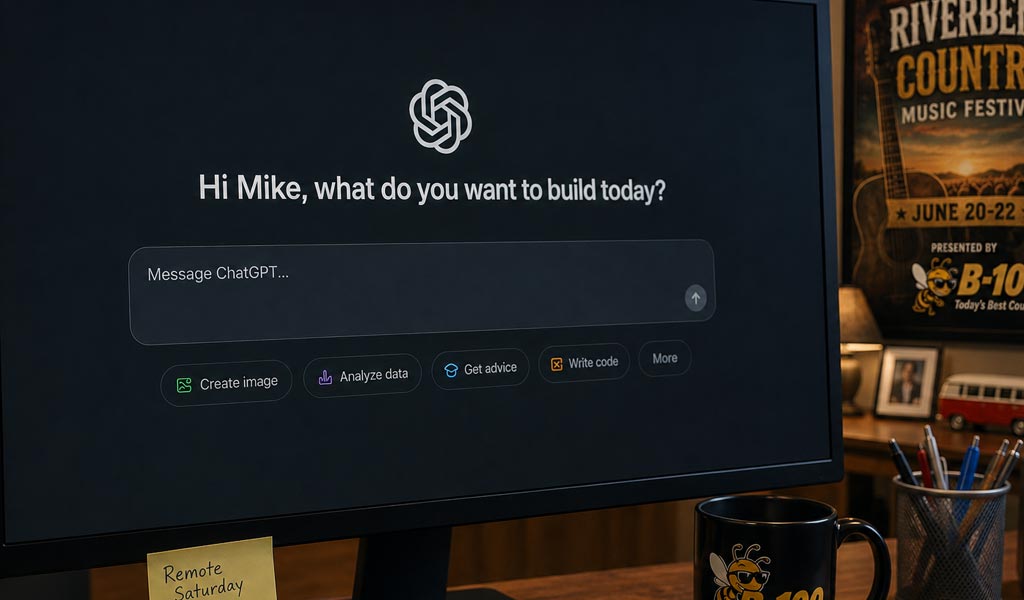
I recently heard a podcaster talking about how he was abandoning WordPress in favor of an AI-generated website. It was a bit unsettling, but I completely understood the appeal. Today, you can describe the website you want, let AI write the code, upload it directly to your hosting account, and make future changes simply by asking. It’s remarkably inexpensive, surprisingly capable, and for many businesses, it may become the obvious choice.
For radio stations, however, I believe it could become one of the biggest digital mistakes you make.
The difference has very little to do with artificial intelligence and everything to do with the job your website has been hired to do. Most businesses have what amounts to a digital brochure. Their website explains what they do, answers a few common questions, provides contact information, and gives potential customers confidence that they’re a legitimate business. If that’s all your website needs to accomplish, AI has dramatically lowered the cost and complexity of getting online.
A radio station’s website has a completely different responsibility.
Your website shouldn’t exist simply because every business needs one. It should be the publishing platform for everything your station does. Every remote broadcast, every local news story, every contest, every community event, every podcast episode, every sports article, every weather update, and every promotion should have a permanent home where it continues attracting listeners long after the microphone has been turned off.
Last week I wrote about remote broadcasts and how we often spend hours planning them, promoting them, staffing them, and entertaining listeners, only to pack everything back into the van and leave with nothing to show for it online. A publishing platform changes that entirely. The photos become galleries, the interviews become articles, sponsors receive additional exposure, personalities create social content, and what was once a four-hour remote becomes digital content that continues attracting visitors months – or even years – after the event itself has ended.
The same is true for local news, community events, obituaries, high school sports, election coverage, and weather emergencies. None of these are pages you publish once and forget. Together they become a growing library of local content that tells search engines, advertisers, and – most importantly – your audience that your station is actively serving the community every single day.
Radio Update recently published an excellent article explaining why newsletters remain one of the most valuable marketing tools available to broadcasters, and I couldn’t agree more. But newsletters don’t create value by themselves. Every link inside that email should point readers toward fresh, relevant content on your website. The newsletter becomes another pathway back to your publishing platform, where listeners discover another story, another event, another contest, or another reason to stay engaged with your station.
Then there’s the business side of the equation.
One of the biggest mistakes broadcasters make is thinking of their website as an expense instead of a revenue-generating asset. Advertisers aren’t buying technology. They’re buying attention. They want their message to appear where local people return day after day because there’s always something new to discover.
A static website may look fantastic on launch day, but if nothing changes after that, there are very few reasons for listeners to return. Fewer returning visitors mean fewer page views. Fewer page views mean fewer advertising impressions. Fewer impressions make it harder to justify premium advertising rates. Saving money on the website becomes meaningless if you’ve also reduced its ability to generate revenue.
By contrast, every new article, photo gallery, event listing, contest page, podcast episode, or community announcement creates another opportunity for someone to visit your website and another opportunity for an advertiser to be seen. Over time, those opportunities compound into something much more valuable than an attractive homepage. They become a growing digital asset that works for your station every single day.
Imagine if Radio Update replaced its publishing platform with a static AI-generated website. It would probably look fantastic, but where would next week’s article go? How would readers browse years of archived content or discover topics they weren’t specifically searching for? The value isn’t found in the website’s design. The value comes from the continuous publishing that happens behind it.
Radio station websites should be viewed exactly the same way.
Will AI eventually generate fully functional publishing platforms that rival today’s content management systems? Almost certainly. Technology has a way of surprising all of us. But that’s not what most people are replacing their content management system with today. They’re replacing a publishing platform with a brochure website, and those are two completely different tools built for two completely different jobs.
None of this is an argument against artificial intelligence. We use AI every day, and I believe it’s one of the most valuable tools available for helping broadcasters accomplish more with fewer people. It can help write articles, summarize interviews, generate ideas, improve headlines, organize content, create copyright-free images, and automate countless tasks that used to consume hours every week.
AI is transforming how radio stations create content, manage workflows, and serve their communities. But the stations that win won’t be the ones using AI to build cheaper websites. They’ll be the ones using AI to publish more local content, more consistently, than ever before. The goal has never been to own the cheapest best-looking website in your market. It’s to own the most valuable digital asset in your market, and those two ideas are becoming easier than ever to confuse.
Pic generated by ChatGPT.
Jim Sherwood is a radio veteran turned digital strategist dedicated to helping radio stations thrive online through engaging websites and mobile apps. As the founder of Skyrocket Radio and host of the Better Radio Websites podcast, he shares best practices to help stations grow audiences and revenue in the digital space. With decades of experience in radio and a passion for connecting content with listeners, Jim ensures that every station—no matter its size—can make a lasting impact online.