


James Corden’s Carpool Karaoke was a feature on his television talk show. You may not know the name of his show (The Late Late Show), which aired from 2015 to 2023. Most didn’t realize Carpool Karaoke was part of the show. They think it was a show. You may have never heard of Corden if it weren’t for his signature feature. Carpool Karaoke is a mini-brand that took on a life of its own. It became so popular that Apple bought and released it on iTunes, resulting in billions of views. It’s safe to call this feature a success.
What’s Your Carpool Karaoke?
Carpool Karaoke is an interview that combines karaoke with a road trip. The concept is immediately familiar, which is part of the magical appeal of this branded feature. But the real magic is that it unlocked the career potential of a likable personality.
Carpool Karaoke is a great feature. It’s not all Corden did on his show, but it is what he’s known for. It’s the first thing people think of when his name is mentioned. Branded features work. So, how can radio personalities find a Carpool Karaoke?
First, understand that features are a powerful attraction, especially for new and developing shows. Personalities in the Familiarity Stage of the Personality Success Path need to be known for one thing to advance to Stage 3 (Growth).
A great feature is a Cume magnet that attracts a larger audience at a specific time for a clearly defined reason. Features add structure, which helps listeners know how to use a show, helps with consistency, and allows the audience to get to know the personalities’ character traits.
The Power Of Features
Most shows have at least a couple of features, but not all features are audience magnets. Check out this dial-test chart (courtesy of Strategic Solutions Research) for a feature called What Are You Doing At The Courthouse? Respondents use a dial to indicate their interest in what they hear. If they like it, they turn it up like a dial on the radio. If they don’t like it, they turn it down. The responses are measured in a graph as shown below.
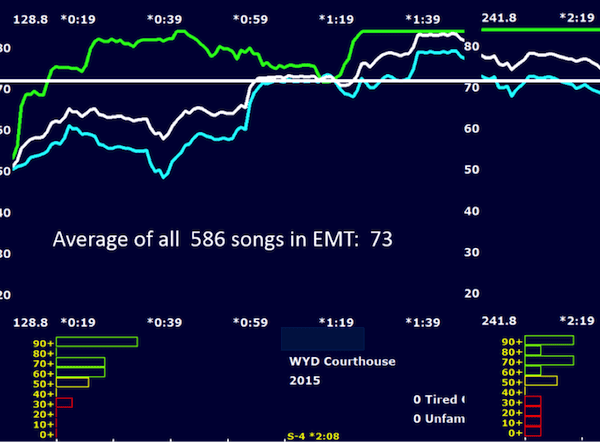
The green line represents listeners who are familiar with the show. The wavy white line measures the total audience, and the blue line is those who listen to the station but are not fans of the show. The solid white line is the average score of all content (including songs) tested in that project. In order to be considered successful, the spoken word content should score at least as well as the average song, or above the solid line.
Notice how the green line (fans of the show) rockets to the top as soon as the feature begins, while the blue line lags. Fans are familiar with it and look forward to it before it starts. That’s the sign of a strong brand. This also indicates that the feature should be heavily promoted. If more listeners knew about it, it could become a driving force for the show (station cume).
How to Create a Feature
The best way to find a feature is to start with a vision for the show’s brand. Is it to probe relationship issues? Are you an expert on pop culture? Start there.
Then, identify character traits. Are you funny? Edgy? Sentimental? Sincere? Patriotic? These traits factor into possible feature solutions.
Now, match the traits to a feature. For example:
Pop Culture: If the show is all about pop culture, do Hollywood News every hour and build in teases and mini-features in other parts of the hour. You might even run promos with updates throughout the day, like this. Become famous for it.
Awkward Situations: If a character takes risks and has an edgy personality, consider prank calls or something with an irreverent or ridiculous premise.
Relationships: For shows that love stories about relationships, Second Date Update, War of The Roses, and Love em Or Leave em are possible options.
Make It A Hit
Whatever you choose, commit to making it a hit. Execute with enthusiasm every single time. That sounds like obvious advice, but it’s easy to get bored and invest less effort.
A great feature is like a hit song. Led Zeppelin has to play Stairway To Heaven at every concert, or the audience will be disappointed. A Rolling Stones concert wouldn’t be the same if Mick skipped Satisfaction because he was tired of it. Country legend Johnny Cash learned the value of playing the hits.
“I went through a period that I didn’t want to sing my old songs. Finally, I decided that I was cheating the audience and myself. I started singing all the old songs with gust and lust like I loved them. Those songs are a part of me. They’re an extension of me when I get in front of that microphone.”
Play your hits with gust and lust, just like Johnny Cash.
Conclusion
James Corden would not be a celebrity without Carpool Karaoke. That one thing became a programming wedge that helped him become famous. Good for him.
Don’t fear the feature. Embrace, develop, curate, and promote them. Those hits are the fastest path to becoming the radio celebrity you want to be.
Pic designed by cookie_studio for Freepik.com.
Tracy Johnson is a talent coach and programming consultant. He’s the President/CEO of Tracy Johnson Media Group. His book Morning Radio has been described as The Bible of Personality Radio and has been used by personalities worldwide.