

If the source of advertising is local businesses and the number of businesses in San Antonio has grown 4.9% since 2020, why is advertising up 24.4%? And why has radio advertising declined 21.6% in that market?
It’s the same story – with wildly varying and incongruent percentages – across America.
The pandemic moved your cheese.
Over 25 years of tracking changes in local media, nothing compares with the speed and magnitude of change in the past four—or what is coming during the next four. At Borrell, we first spotted something different in our 2025 forecasts. Our newest update this October will highlight an acceleration of that transformative trend.
The issue boils down to a change in radio’s sole source of revenue: local businesses. The U.S. added 1.7 million business establishments between 2020 and 2025, a 16.3% increase from 10.5 million to 12.2 million. But that national average masks a story of radical divergence happening beneath it. It wasn’t a story of growth so much as churn. Businesses that support traditional media companies (retail in particular) were hit hardest, shrinking in many markets. They were replaced by new businesses that started out advertising in digital media, which is typically targeted and thus “unseen” unless your cookies or general profile serves you the ad.
Here’s why radio has been having such a hard time selling radio: Sales reps keep chasing the elusive fat wildebeests of local advertising. What they don’t realize is that the herd is skinnier and less plentiful than they were a half-dozen years ago.
Most sales departments remain fixated on obsolete ad-tracking reports, stalking familiar prey while missing whole herds that those reports are unable to see. It’s easy to keep looking at those reports and staying on that rat wheel. You can readily “see” traditional media advertising. There’s a finite number of radio, TV, newspapers, and billboards in every market, and the ads are easy to track. But here’s the thing: That covers less than one-fourth of all advertising. And’s it keeps shrinking.
The other three-fourths of local advertising is spent in digital media. And that’s nearly impossible to track.
Not to mix metaphors, but the tools that radio industry is using to identify who’s advertising don’t tell sellers where the puck is going. Worse, they don’t even say where it is. They tell you where it was last week, last month or last quarter. And because everybody’s got the same report, everybody’s chasing the same “spent” puck.
The composition of local business is changing alongside the media mix. Healthcare, home services, recruitment, education, fitness, travel and experiential businesses are expanding. Many are smaller, younger and less visible to traditional monitoring services because they began with search, social, streaming and direct-response marketing—not broadcast.
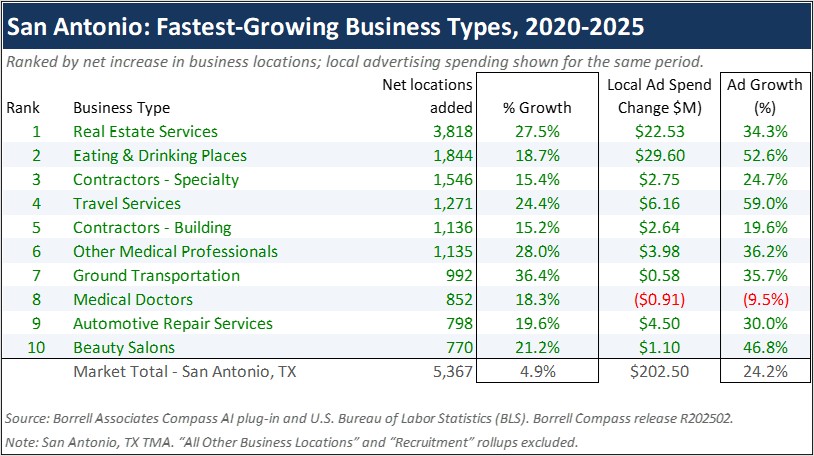
Consider San Antonio. Business locations increased only 4.9% from 2020 to 2025, but local advertising grew 24.2%. Digital spending surged 41.7%, while non-digital spending declined 4.9%. Restaurant ad spending grew 52.6%, real estate $34/3%, and specialty medical professionals 36.2%.
The pattern travels. Erie’s business base is forecast to expand 11.2% from 2024 to 2026. Dallas-Fort Worth should add about 250 HVAC locations by 2029, when category advertising approaches $44 million. Across nine radio markets we examined, total local advertising rises roughly 10% to 14% through 2029. Radio, however, declines 10% to 14%, while online audio grows 33% to 38%.
There is another overlooked opportunity: 59% of SMBs buy media directly, and 62% have no full-time marketer. They need expertise, but they want transparent measurement, affordability, industry knowledge and less pushy selling.
This is not a smaller prospecting universe. It is a different one. And for some markets, a much larger one than just a few years ago. Looking to 2028, our forecasts show the transformation and growth isn’t abating.
Sellers still endlessly calling the same auto dealers, furniture stores and personal injury lawyers are fishing in a shrinking pond. Winning requires continuously mapping new businesses, emerging categories and migrating budgets—then combining radio’s reach and credibility with streaming, targeting and measurable response.
The cheese is still plentiful. But it is no longer sitting where radio sellers continue to look.
Pic AI generated using Gemini.
Gordon Borrell is the CEO of Borrell Associates INC, a multi-million-dollar market research firm that tracks and forecasts the local media and advertising industry and serves over 1,300 clients worldwide.