


Are you playing The Ratings Game? That’s a serious question. Some stations chase away fans trying to capture an extra quarter-hour or two from ratings respondents representing a tiny fraction of the population. And they’re different types of people. A strong case can be made that many (if not most) stations should not play the game, especially those that evoke strong emotional bonds with their audience. Playing the Ratings Game to maximize quarter-hours based on a severely flawed, outdated, and hopelessly undersampled process can (and has) cause great stations to become ordinary. Contemporary Christian stations come to mind. But if you are going to play the game, you have to play by the rules of the ratings game.
The Rules Of the Ratings Game
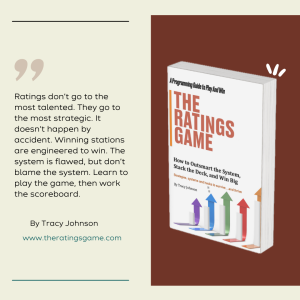
Every broadcaster complains about the ratings process, yet they continue to participate and complain about how the game is played. Maybe you don’t like the rules of the ratings game, but they are the rules, and nothing you can do will change it.
An athlete can’t win a basketball game by playing with the rules of a football game. That would make no sense, justifying failure with a comment like, “Well, I’m a better football player, so no big deal.”
Or what if you tried to play a new game using outdated rules? The other players have adapted to new regulations, but you’re clinging to mechanics that worked before mobile phones, Google, email, social media, and AI were a thing?
How Has The Game Changed?
The rules of the game have changed in almost every way. Here are a few that deserve your attention:
Time Spent Listening is a fraction of what it has been, and listeners switch stations whenever something annoys them. Are you playing your best songs often enough? Do you program high-profile features enough to resonate? Are you effectively and often promoting key benefits and tune-in occasions?
Tune Out Is Skyrocketing because of lower attention spans and less tolerance for things the listener dislikes, but there’s another factor. Most listening happens in the car, the most convenient location to tune out. It’s right in front of you, just an arm’s reach away. Since it’s easy to tune out, how does this affect programming?
Top of Mind Awareness has plummeted, partly because the bar is higher on all forms of entertainment. Hilarious videos, breaking news, and exciting discussions are a click or tap away. Listeners are tuning out, but are you doing anything to attract return engagement?
Teasing and Promotion is more complex than ever because the audience is numb to hype and clickbait, yet if you aren’t building anticipation and setting appointments, you’re missing opportunities. You have to tease to get quarter hours. You have to promote. But it has to be freakin’ great!
Every segment carries more weight than ever before. Since listening is down, each quarter hour has a greater impact on your results. You can’t afford anything less than A-plus material in every single segment.
Other Rule Changes
As the game’s rules continue to evolve, your skills must adapt. Here are a few more to consider:
What’s An Occasion? Rather than five minutes to earn a listening occasion, what will happen when that is trimmed to three minutes? How about two minutes? One? How can you convince your audience to tune in for six minutes (three minutes in two quarter-hours for a feature, such as :27 to :33) to earn 30 minutes of credit? This is a game-changer.
The Digital Bonus: Rating companies award a “headphone bonus” because meters cannot account for online listening through earbuds or headphones. Since they don’t know how to assign credit, they add up to 75% of bonus listening for measured online listening. That’s incredibly inaccurate and ridiculous. But it’s the rules of the ratings game, so how does that impact how you curate, distribute, and promote your streams and apps?
Online Credit: Even more suspect is the rule that credits on-demand listening with ratings credit if the audio registers on a meter within 24 hours of the original airing. Is this a fair rule? Most of the on-demand audio doesn’t include commercials the advertiser pays for (and bases the rate on measured listening). Still, that’s a rule. Play accordingly. Combined that with the headphone bonus. It’s like having extra players on the field!
Conclusion
Rating rules cause programmers to rant and rave to talent about clock management and to get into stop sets on time. They cluster an unbearable (and unlistenable) number of commercials in a cluster to sacrifice a quarter-hour in hopes of clearing out other quarter-hours to retain more listening. Commercial free sweeps eliminate listening “off ramps” to spike ratings. Do these things provide listening value? Do they build fans? That’s a fun debate.
You probably hate many of the rules of the ratings game because it’s not what you “signed up for.” That’s normal, and it’s okay. But you have two choices: Play the game to win based on the rules or play a different game. Don’t get caught in the middle, caring about the game’s results enough to handcuff your brand but not enough to win fans. If you’re going to play, play to win, but realize the rules have changed and will continue to evolve. Have you?
Radio ratings are a game. It’s not about making the most popular station overall. It’s about attracting meters or diaries to claim AQH and share.
That’s covered in-depth in The Ratings Game, a comprehensive book about the ratings process, its flaws, and how programmers can exploit the system and play to win.
Check out the book at www.TheRatingsGame.com.
Pic designed by fabrikasimf for Freepik.com.
Tracy Johnson is a talent coach and programming consultant. He’s the President/CEO of Tracy Johnson Media Group. His book Morning Radio has been described as The Bible of Personality Radio and has been used by personalities worldwide.