


Most radio stations promote themselves with industry jargon. We’re the station that plays the most music, has the best variety, are your spot for throwbacks, and are #1 for today’s hits! Great. So are a dozen other stations in every market. And there are a dozen playlists on Spotify that do it, too. With customization. Here’s the problem: listeners aren’t choosing a station because of a clever music position or your promise of fewer commercials. They’re choosing how they want to feel. That’s why a winning programming strategy targets mood, not facts. You’re selling format features, but listeners are buying emotion.
Why Do Listeners Choose a Station?
Think about it: why do you turn on a particular show or station? Is it because of the logo?
The slogan? The promise of “commercial-free music hours”? Probably not. Listeners tune in because they want something to happen inside of them. A lift. A laugh. Or to feel nostalgic. Most listeners use the radio to escape. They choose stations by mood. And a programmer who targets mood has a huge advantage.
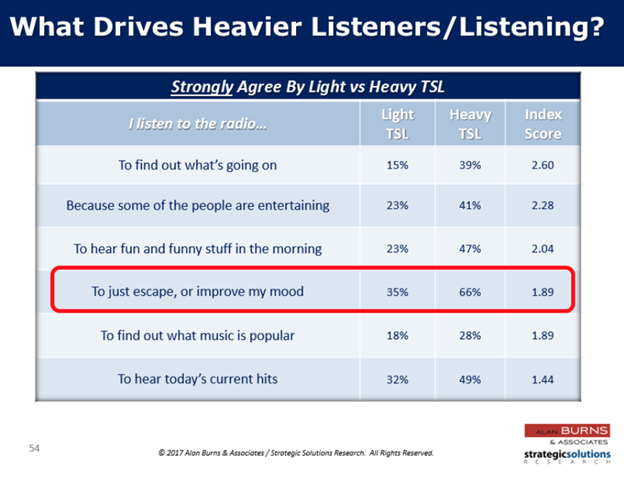
But that’s hard because it doesn’t fit into a formula. A groundbreaking study from Strategic Solutions Research and Alan Burns & Associates asked listeners whether they felt their favorite station “understands their life.” The theory was simple: the more a brand understands the emotional landscape of its audience, the stronger the bond. And the data backed it up.
When asked why they chose their favorite station, 90% said they do it “to escape or improve my mood.”
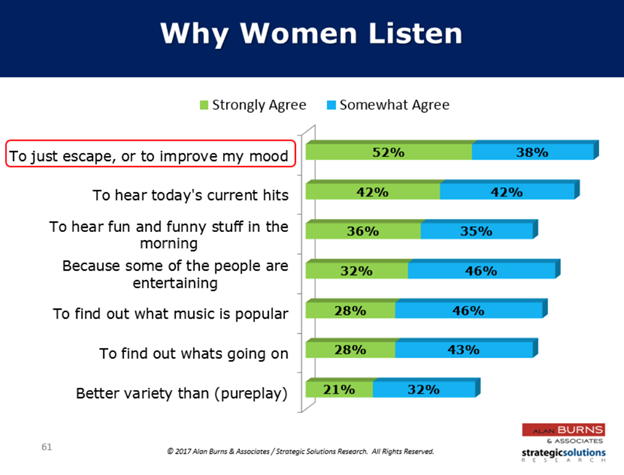
They don’t want more songs, fewer commercials, or more variety. They want to feel something better than they feel right now. That insight is a game-changer for programming strategy.
Mood = Loyalty. And Loyalty Drives Ratings
Here’s the real kicker: just 10% of your audience delivers up to 90% of your quarter hours. Let that sink in. It means fans drive your ratings. Not casual cume. And the best way to convert casual listeners into fans is to connect emotionally. To become their go-to station when they want to feel a certain way.
Yet most stations don’t program for mood at all. They program for “flow,” “variety,” or “positioning.” They promote what they do. But they fail to tell listeners why it matters.
Define Your Station’s Mood
So, let’s devise a strategy that targets mood. Start by asking: What’s your station for?
Are you the soundtrack to getting through a stressful day?
The station that makes people laugh out loud?
The place to return to the “good old days”?
The background that helps listeners feel less alone?
The source of confidence and energy during a morning commute?
Whatever it is, it better be specific, intentional, and relentlessly clear. Because if your station doesn’t have a defined mood, listeners won’t either. And if they don’t feel something, they won’t stay.
This mood should shape everything from music choices that may not fit neatly into a “format” box to the look of your logo. It influences how personalities speak, the content they choose, and the pacing of segments. You’ll craft contests and promotions based on your desired brand mood, and produce promos and imaging to match. Even the colors in your brand style will be chosen to support the mood.
A mood isn’t a marketing angle. It’s not a mission statement or series of clever positioning lines. It’s your brand’s emotional fingerprint.
You Can’t Fake a Feeling
Here’s the trap: it’s easy to declare a mood. “We’re the fun station” is a nice goal, but does the listener experience that in every moment they spend with you?
Owning a mood takes more than saying it. It takes consistency, creativity, and proof. There may be room in a market for multiple Top 40 or Country stations, but there’s only room for one station that makes listeners feel a very specific way.
If you haven’t earned that feeling, you haven’t won the mood. And if you haven’t won the mood, you’re just another preset button fighting for scraps.
Also, understand you can’t “set it and forget it.” Once you define the mood, you have to earn it repeatedly. That means regular injections of fresh ideas, features, and promotions that reinforce the emotional space you want to own.
Want to be the fun station? You better surprise listeners often. Want to be the safe, comforting voice? You better show up reliably and empathetically—even in production and tone. Habits form when novelty is balanced with familiarity. Mood is the glue that holds it all together.
Promote The Feeling, Not the Features
So here’s your playbook:
Stop promoting your stuff—songs, artists, number of tracks in a row.
Start promoting your mood.
Listeners don’t say, “I listen to 104.5 because they play 80s, 90s, and more.”
They say, “That station always makes me smile.”
So smile with them.Every commercial, every event, every contest should radiate the mood you’re trying to own. That’s how brands move from being functional to being essential.
To build a brand that earns loyalty and drives ratings, be a station that targets mood. What mood do you own?
Pic AI generated by Envato Labs.