

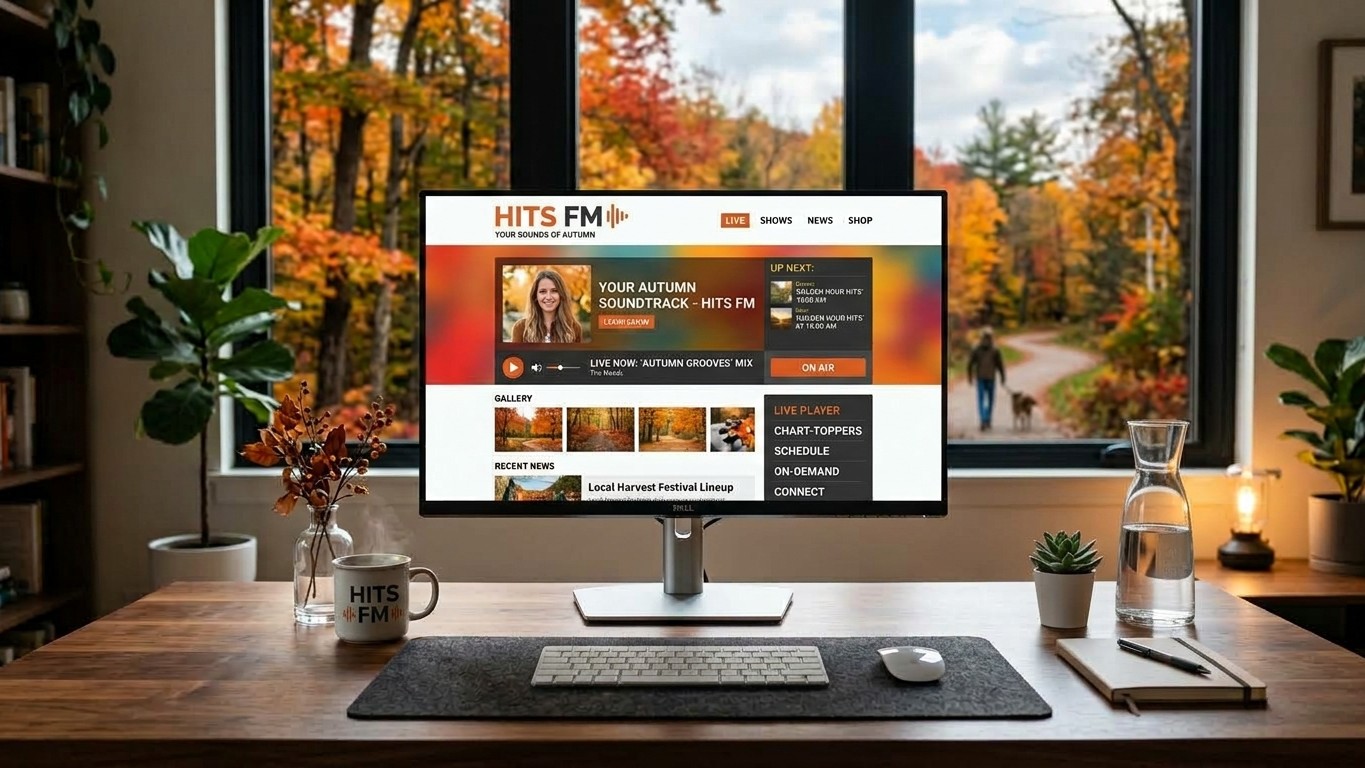
Give Your Digital Front Door a Fall Makeover
Radio programmers spend hours perfecting music, personalities, imaging, promotions and positioning. Then somebody clicks the station website and encounters something that looks like it was programmed by the accounting department.
Uh-oh.
Your website is part of the station’s product. It should immediately communicate the same brand, attitude, entertainment and local connection listeners hear on the air. As you prepare for Fall, give your website a programming review. Start with these ten principles:
- Look Alive!
Nothing makes a website feel abandoned faster than outdated content. Today’s date, current weather, breaking local information, recently played songs and fresh promotions tell visitors: somebody is home.
Check every page for expired contests, ancient concert announcements and personalities who left the station two years ago. Digital archaeology belongs in a museum.
- Scream Local.
Your website should immediately tell visitors where you live. Feature community events, concerts, sports, weather, local personalities, photos and stories. A visitor shouldn’t land on “Star 102” and wonder whether they’re in Omaha, Orlando, or on another planet. Streaming services can deliver music anywhere. Your competitive advantage is HERE.
- Make the Format Obvious.
Within seconds, visitors should understand what your station offers.
Display your positioning statement prominently. Showcase core artists. Feature recently played songs and a clear Now Playing display. If you’re “The ’80s to Now,” don’t make visitors conduct a forensic investigation to discover it.
- Kill the Clutter.
Too many station websites resemble a digital yard sale: banner ads, pop-ups, contests, videos, buttons, promos and seventeen things screaming CLICK ME!
Apply the same principle you use on-air: one thought at a time. Give the logo room to breathe. Establish a clear visual hierarchy. Make the most important benefits easy to find. Your homepage shouldn’t require air-traffic control.
- Sell the Click.
Don’t simply label a button CONCERTS. Give visitors a reason to use it. “See Who’s Coming to Town.” “Win Tickets Before You Can Buy Them.” “Meet Us at Friday’s Festival.” Benefits beat labels. Sell the destination before asking for the click.
- Tease, Tease, Tease.
Great radio programmers understand forward momentum. Apply it digitally. “Tomorrow morning: Your chance to win $1,000.” “Concert announcement at 8 AM.” “New Impossible Trivia question tomorrow at 7:20.”
Give visitors reasons to return. A website shouldn’t merely document what already happened. It should promote what happens next.
- Recycle Digital Visitors Back to the Radio.
This may be the most overlooked website strategy of all. Your website shouldn’t become the place listeners go instead of listening. Use it to create tune-in. Promote morning-show benchmarks, contests, music features, special weekends and appointment times. Every important page should answer:
“What’s happening on the station that I shouldn’t miss?”
The website isn’t the finish line. It’s another entrance to the station.
- Turn Anonymous Visitors Into Known Listeners.
Make it easy—and worthwhile—to join your listener database. Offer benefits for registering: exclusive contests, concert presales, station events, special offers, breaking information and insider opportunities.
Don’t say: “Join Our Email List.” Instead, try: “Get First Shot at Tickets & Prizes.” One sounds like work. The other sounds like fun.
- Speak Listener, Not Radio.
Listeners don’t necessarily understand our industry language. Use simple, active navigation: Listen Live. Win. Concerts. Morning Show. Events. Contact Us. This is not: “Programming. Promotional Opportunities. Station Information Resources.” Nobody should need a broadcasting degree to find the contest page.
- Stop “Selfing.”
Radio stations love talking about themselves. Our new studio! Our new van! Our staff meeting! Here’s another picture of our morning team! Before posting anything, ask the magic question: “What’s in it for the listener?”
Personalities matter because listeners have relationships with them. Events matter because listeners can attend them. Promotions matter because listeners can win. Make the listener the star of your website—not the station.
The Lund Lesson
Your website should be the digital version of your best hour on the air. It should be local, entertaining, current, easy to use, benefit-driven and unmistakably YOU. A great station website doesn’t simply tell people about the radio station. It gives them another reason to listen.
The Lund Challenge
Pull up your station homepage—but don’t touch anything for five seconds. Then answer five questions:
Where am I?
What station is this?
What does it play?
What’s happening locally?
Why should I listen right now?
If you can’t answer all five immediately, neither can a listener. And this Fall, give your website the same programming attention you give your radio station. After all, nobody ever improved their ratings with a “Click Here for More Information” button.
Pic AI generated using Gemini.
John Lund is President of the Lund Media Group, a radio programming, broadcast consulting, and research firm with specialists in all mainstream radio formats.