


This will be a familiar message for those who subscribe to Sun Tzu’s The Art of War. Tzu was an ancient Chinese general and military strategist. His philosophies on fighting wars became a marketing playbook for many brands. One of his principles of war is to apply resources to attack a narrow, defined target. It’s called the Concentration of Force, and every marketer (including radio stations) can implement the concept to enhance their results.
Put More Power Into Programming, Marketing and Promotion
This concept directs all available assets to one point with a singular focus. Advertising guru Roy Williams (The Wizard of Ads) explains how it applies to marketing:
One of the most common mistakes in advertising is to spread your ad budget across several different media so that you don’t leave anyone out. But persuasion – in most instances – requires repetition and familiarity.
Would you rather reach 100% of the people and convince them 10% of the way, or reach 10% of the people and convince them 100% of the way? Don’t spread your money too thinly by chasing the unicorn of “media mix.”
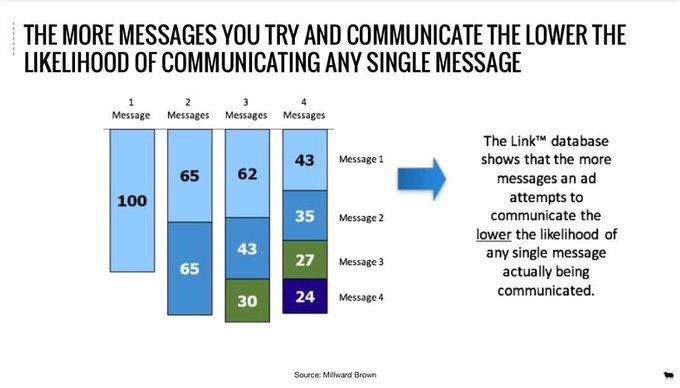
Millward Brown, a global research company, measured the effectiveness of advertising and proved that multiple messages fail:
Even by adding a second message to an ad, the likelihood that consumers take away either of them drops from 100% for a single-message ad to only 65%. By the time fourth messages are added, the best likelihood of any individual message getting through to consumers drops to 43%.
Here’s a graphic that explains it in more detail:
The Radio Application
One of my mentors, Alan Burns, first introduced me to the concentration of force. Alan is a student of Learning Theory and how it applies to influencing radio listener behavior.
The Concentration of Force can be demonstrated with this fascinating object lesson:
The Audience: Stretch an ordinary sheet of paper before you. Hold it tightly. This paper represents the audience’s level of awareness. To impact listeners, a message must cut through this sheet of paper to get into their minds. It should be easy to punch through that thin sheet of paper. But is it?
The Message: Ask the strongest person you know to place the palm of their hand in the center of the paper. The five fingers represent a brand’s marketing messages to “teach” a listener. Ask them to apply equal force to all messages (fingers). No matter how hard a partner presses on the center of the paper, they will not be able to penetrate the single sheet of paper. Nothing cuts through.
A Single Message: Now, demonstrate the Concentration of Force. Ask them to place one finger on the sheet of paper and apply just a little pressure. They cut through immediately.
The lesson: It’s only possible to teach listeners one thing at a time. When well learned, another concept can be introduced. This is the fastest way to build a meaningful brand as a personality.
This is why The One Thing is a valid approach for programming and personality growth.
Conclusion
A personal trainer will tell you that most new clients initially say they want to lose a few pounds, firm their legs or butt, or “look better.” The trainer listens, then ignores what the client says they want. She puts them on a program to train the core muscle group. The first few weeks are spent working the abs and deep core muscles. Why? To reach desired results, they must first build a foundation, one step at a time. The Concentration of Force leads to faster progress.
The Concentration of Force is a real thing, and you can see it in action all around you. This is how Disney manages new attractions and great marketers conduct successful ad campaigns. Isn’t it time to apply it to your station?
Pic by Master1305 for Freepik.com.
Tracy Johnson is a talent coach and programming consultant. He’s the President/CEO of Tracy Johnson Media Group. His book Morning Radio has been described as The Bible of Personality Radio and has been used by personalities worldwide.