


What’s better? A national contest to win $1000 that is heard on hundreds of stations, or a local station contest for a lesser prize. Many believe radio listeners prefer more chances to win a smaller prize in a local contest versus a larger prize in a national contest. They perceive that being local means less competition vying for the smaller prize and a better chance to win.

The research and media marketing firm, NuVooDoo, released the results of a national study among 3000 respondents in PPM markets ages 14-54 regarding small versus large prizes and local vs. national contesting. Results change by format.
They found that the 25th caller winning $250 locally (59.8%) is preferred over the 25th caller winning $1000 on a national basis (35.7%). Rock and Alternative P-1 listeners slightly preferred the local contest at 55.3%. CHR P-1s preferred small local prizes at 63.3%. Classic Rock, Classic Hits, and Adults Hits P-1s strongly preferred local small prizes at 68.6%. Country P-1s overwhelmingly prefer small prizes given away locally at 76.3%. But Urban respondents were nearly a toss-up between local and national (50.6% national prize).

But does the contest engage the rating respondents, or does it only engage the “contest pigs?” Does the “25th caller” execution actually add to listener fatigue in the promotion of the contest and the presentation? Does the contest execution cause listener fatigue, causing eventual non-engagement and possibly tune-out?
The answer may be in the evolution of the popular TV game show Family Feud to its current form with Steve Harvey as host. In the early years, the show had a strong emphasis on the winning family winning $20,000 and the possibility of winning a brand-new car. Family Feud would start the show off with a display of the car and before “Fast Money” the winning family would be prompted to say “TWENTY THOUSAND DOLLARS!”
Today, Steve Harvey goes directly to the families to play the game like you would with your air staff beginning their breaks with content. The philosophy is to engage the viewer/listener immediately.
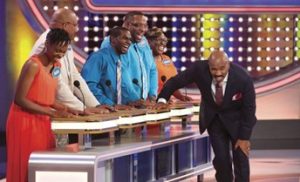
Throughout the show, Steve “plays” with each member of the competing families, and the risqué nature of the questions/answers gives him an opportunity to make funny facial expressions. The key to Family Feud’s success is not who wins the money or the car. It’s about the entertainment factor and the opportunity for the audience to “play along” by answering the questions themselves and seeing how they match up. This “play along” attribute also made the TV game shows Jeopardy and Wheel of Fortune successful.
When designing your contests, consider how you will best engage the audience and not depend on the prize. If less than 5% of the audience actually participates in contests then why not make your contests engaging to the other 95%?
The longevity of the “Secret Sound” contest bears truth since the prize may not be huge, but it engages the audience with intrigue and anticipation. You want listeners to play along (as with all trivia-based contests) whether they call in or not. When they are engaged, they find out the resolution.
Conclusion: Design contests with listener engagement to drive higher ratings with increased TSL.
Did you find this article useful?
Pic designed by azerbaijanstockers for freepik.com.
John Lund is President of the Lund Media Group, a radio programming, broadcast consulting, and research firm with specialists in all mainstream radio formats. You can leave a comment below or email him at John@Lundradio.com.